





The next major war may not begin with tanks crossing a border or fighter aircraft entering contested airspace.It may start with a silent cyberattack on military networks, the jamming of satellite communications, an autonomous drone swarm overwhelming air-defence radars, or an artificial intelligence system identifying and disabling targets faster than human commanders can respond.Modern warfare is going through its biggest transformation since the atomic bomb, with power shifting from large-scale firepower to faster algorithms, control of the electromagnetic spectrum and advanced energy weapons.The defining feature of this new arms race is not simply that individual weapons are becoming more powerful. It is that they are becoming faster, more networked and increasingly autonomous.The next war will therefore be less about possessing one “wonder weapon” and more about who can integrate emerging tech into a unified fighting machine.
1. AI battlefield systems: Faster & deadlier war
Artificial intelligence is not a weapon in itself but it can make almost every other weapon faster and deadlier.Its role extends from analysing satellite imagery and drone video to identifying targets, predicting enemy movements, allocating weapons and managing logistics.The most important advantage is speed.Military planners traditionally worked through the “observe, orient, decide and act” cycle. AI compresses each stage by processing enormous volumes of data from radars, satellites, aircraft, drones, ground units and electronic sensors.The United States’ Project Maven is one of the best-known and earliest examples. Launched in 2017 to apply machine learning to intelligence, surveillance and reconnaissance, it evolved into an AI-enabled system for detecting and classifying objects in imagery. Palantir’s Maven Smart System and Anduril’s Lattice are examples of platforms designed to fuse sensor data and give commanders a common operational picture. Project Maven has also been integrated into Nato’s command architecture.
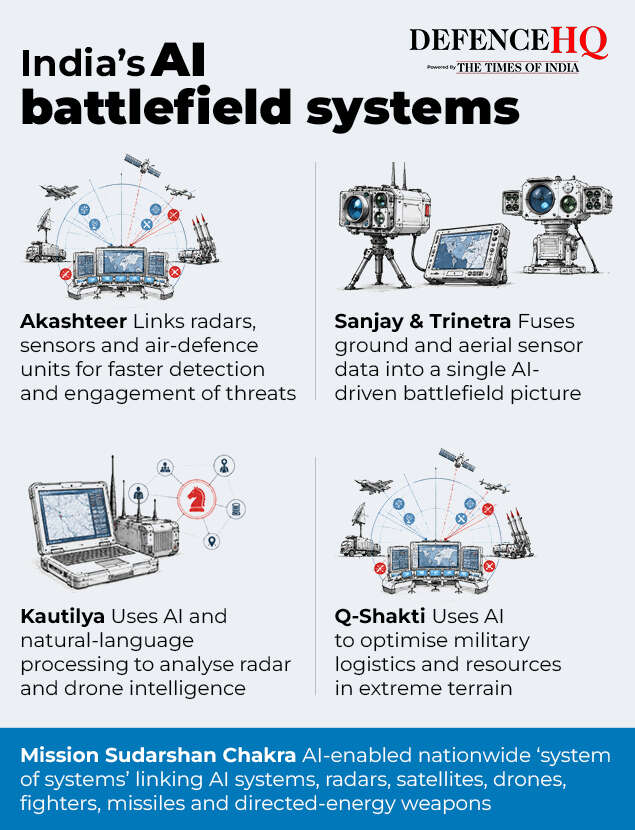
AI is not a weapon by itself — it is the force multiplier that can make almost every other weapon faster, smarter and deadlier.
China is pursuing similar concepts through networked command systems, intelligent weapons and unmanned platforms.The long-term objective is not necessarily to remove humans from warfare, but to give commanders an information advantage and allow one operator to control multiple platforms.India has also been moving towards automated air-defence and battlefield-management systems.Bharat Electronics’ Akashteer integrates radars, sensors and air-defence units into a common network. Its value lies in improving the speed and accuracy with which existing weapons can detect and engage hostile aircraft, helicopters, missiles and drones.The system is part of the Defence Research and Development Organisation’s broader C4ISR (Command, Control, Communications, Computers, Intelligence, Surveillance and Reconnaissance) framework. Akashteer is the core of the Indian Army’s Air Defence (AAD) system; and it connects smoothly with IACCS (Indian Air Force) and TRIGUN (Indian Navy), creating a clear and real-time picture of the battlefield.Project Sanjay & Trinetra fuses multi-source data from ground and aerial sensors into a single common surveillance picture, creating AI-driven heat maps and shortening target acquisition timelines. Kautilya & Q-Shakti are advanced AI platforms launched to process massive radar/drone intelligence feeds via natural language processing (Kautilya) and optimise military logistics in extreme terrain (Q-Shakti).India also launched Mission Sudarshan Chakra in 2025, which is envisioned as an AI-enabled nationwide “system of systems” that links radars, satellites, electronic warfare, drones, fighters, missiles and directed-energy weapons through integrated command-and-control networks such as the IACCS and Akashteer.The architecture is expected to bring together the DRDO, IAF, Army and Navy, with AI processing data from ground, air, maritime, undersea and space-based sensors to identify threats, assess them and rapidly assign the most appropriate interceptor or weapon.
2. Drone swarms: When numbers become a weapon
The drone revolution has already changed warfare in Ukraine and the Middle East. But the next step is not simply more drones. It is swarms.A conventional drone is individually controlled or follows a pre-programmed route.A swarm can distribute tasks between multiple machines. One drone may search for a target, another may relay communications, another may jam sensors and several others may attack – all without receiving constant instructions from a human operator.This creates a particularly difficult problem for conventional air defences. A missile costing hundreds of thousands of dollars is not an economically sustainable response to a drone costing a few thousand dollars.The US has experimented with the Perdix micro-drone swarm and the Low-Cost UAV Swarming Technology, or LOCUST. China has demonstrated large-scale swarm operations with its Atlas system, while Ukraine has demonstrated how inexpensive UAVs can destroy high-value military targets.The defining technology is not the drone itself but the coordination architecture.
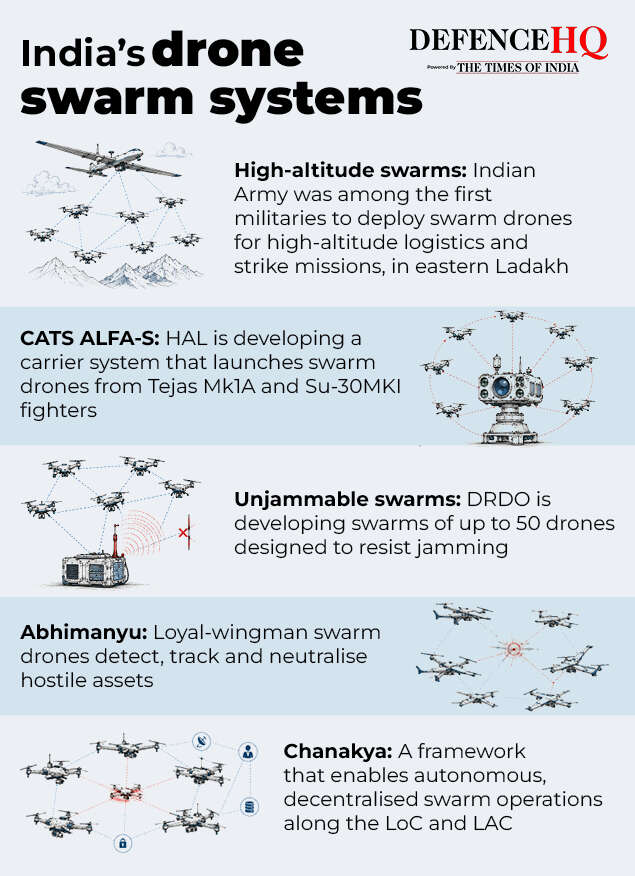
It’s not the drone that changes warfare. It’s the architecture that makes them act as one.
India is moving rapidly in this sector.The Indian Army was among the world’s first militaries to operationalise swarm drones for high-altitude logistics and strike missions in eastern Ladakh, procuring systems from domestic startups like NewSpace Research & Technologies and Raphe mPhibr.The DRDO is also fine-tuning an unjammable swarm consisting of up to 50 drones.Meanwhile, Hindustan Aeronautics Limited is developing the CATS ALFA-S (Air-Launched Flexible Asset Swarms), a air-launched carrier capable of releasing dozens of loitering swarming munitions from Tejas Mk1A or Su-30MKI fighters.India has also developed the Abhimanyu loyal wingman concept and is working with private companies on autonomous unmanned aerial vehicles, loitering munitions and swarm-control software.L&T has developed the Chanaka, which is a decentralised UAV swarm autonomy framework. It enables distributed decision-making across a self-organising swarm without a central point of failure, allowing drones to assign localised roles (like scout, jammer, or striker) for real-time patrols along the Line of Control (LoC) and Line of Actual Control (LAC).
3. Hypersonic missiles: Speed that breaks the defensive equation
Hypersonic weapons travel at speeds above Mach 5 while retaining the ability to manoeuvre. That combination makes them significantly harder to detect and intercept than conventional ballistic missiles.The major technologies are broadly divided into hypersonic glide vehicles and hypersonic cruise missiles.Russia has deployed systems such as the Kinzhal and Avangard in Ukraine, while China has fielded the DF-17 with a hypersonic glide vehicle. The US is developing systems including the Conventional Prompt Strike and various air-launched hypersonic programmes.
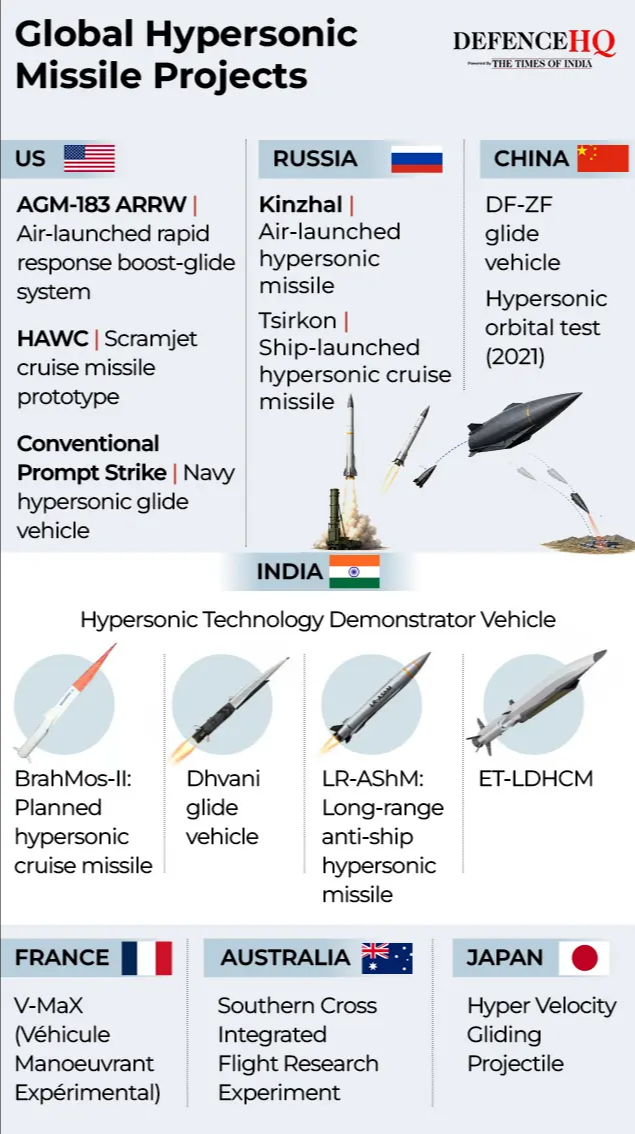
Hypersonics could eventually complement India’s existing ballistic and cruise-missile arsenal
In November 2024, DRDO conducted the first flight trial of a hypersonic missile with a range greater than 1,500 km.It is also developing the Long-Range Anti-Ship Missile (LRAShM): A boost-glide hypersonic weapon built for the Navy for coastal defense and maritime strikes; Hypersonic Technology Demonstrator Vehicle (HSTDV): An unmanned scramjet demonstration program validating high-speed atmospheric flight and propulsion; Shaurya Missile: A canister-launched tactical hypersonic surface-to-surface system with a range up to 1,900 km; and BrahMos-II: A hypersonic evolution of the supersonic BrahMos cruise missile partnership.India’s Project Vishnu is a classified indigenous Hypersonic Glide Vehicle initiative, designed to integrate a long-range strategic booster with a maneuverable hypersonic glide body that can travel at speeds of Mach 8.Hypersonics could eventually complement India’s existing ballistic and cruise-missile arsenal, including the BrahMos family.
4. Laser weapons: The era of almost-free interception
Laser weapons represent a completely different approach to air defence.Instead of firing an expensive interceptor missile, a high-energy laser can destroy drones, sensors and projectiles at a fraction of the cost.The US has experimented with systems such as the Helios, while Israel’s Iron Beam is designed to provide high-energy laser interception. The UK is developing the DragonFire laser weapon.
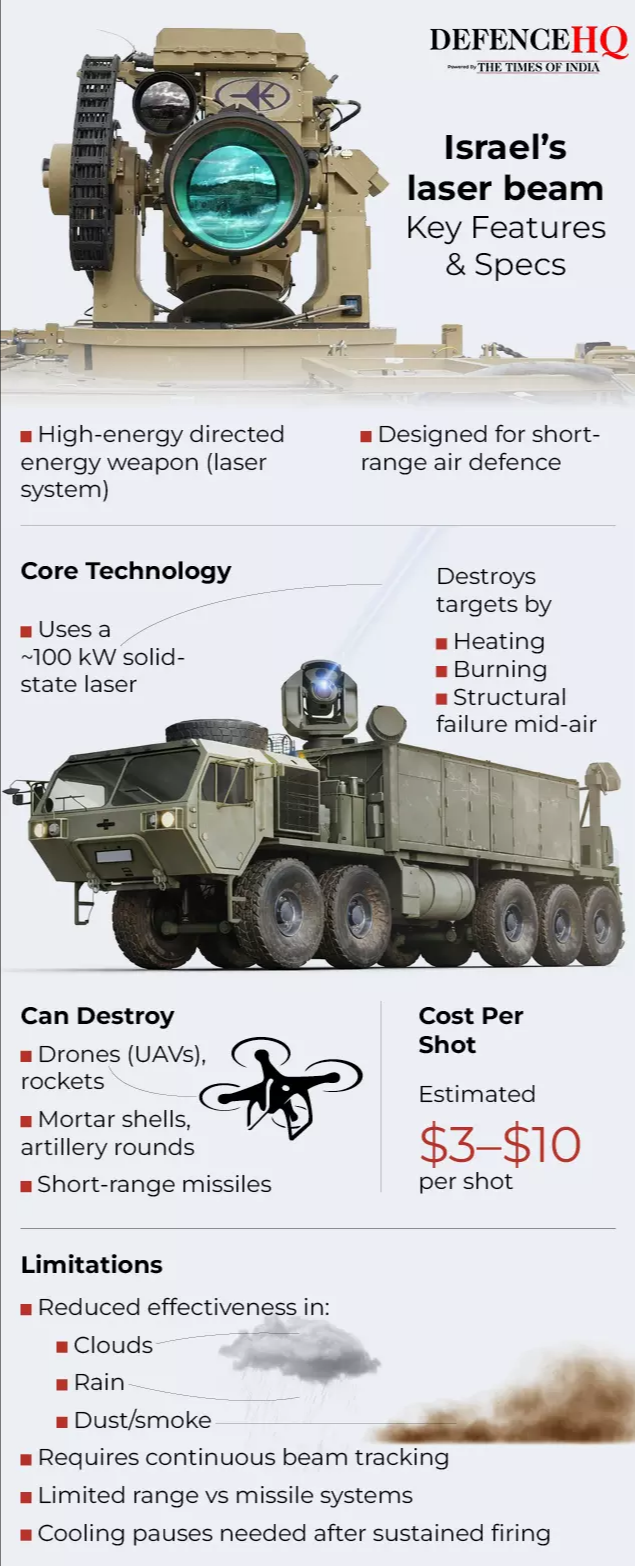
Iron Beam uses a powerful laser to destroy targets
India’s DRDO is working on the Mk-II(A) system. In an April 2025 demonstration, the 30-kilowatt class system engaged fixed-wing drones, drone swarms and surveillance sensors.The DRDO is also developing the more powerful Directionally Unrestricted Ray-Gun Array (DURGA-II), which is a 100kW weapon designed for integration onto naval destroyers and mobile land platforms.DRDO and BEL have also successfully manufactured and deployed 2kW and 10kW truck-mounted anti-drone laser systems with integrated radar and day/night sensors for point defence around high-value military installations.Besides laser weapons, countries are also developing directed-energy weapons.They include high-energy lasers, high-power microwave weapons and other systems capable of delivering electromagnetic energy to a target.High-power microwave weapons are especially relevant to drone warfare. Instead of burning a single target, they can disrupt or damage the electronics of several drones within an area. This makes them attractive against swarms.The US has tested microwave systems such as THOR and Leonidas, while Russia has developed the Peresvet system.India’s private sector is also entering this field. At Aero India 2025, Bengaluru-based Tonbo Imaging showcased WaveStrike, a high-power microwave system designed to counter UAVs in a 3 km-area.
5. Electronic warfare: A battle for the airwaves
A modern military depends on radio frequencies for communications, navigation, radar, satellite links and weapon guidance.Take away that spectrum and a technologically advanced force can be easily blinded and grounded.Electronic warfare (EW) is therefore becoming one of the most important invisible battles.It involves three broad activities: electronic support, which detects and identifies enemy emissions; electronic attack, which jams or deceives them; and electronic protection, which keeps one’s own systems functioning in a hostile electromagnetic environment.The US’ EA-18G Growler, Russia’s Krasukha and Israel’s Hypnosis and Scorpius systems are the best-known examples of dedicated EW capabilities.
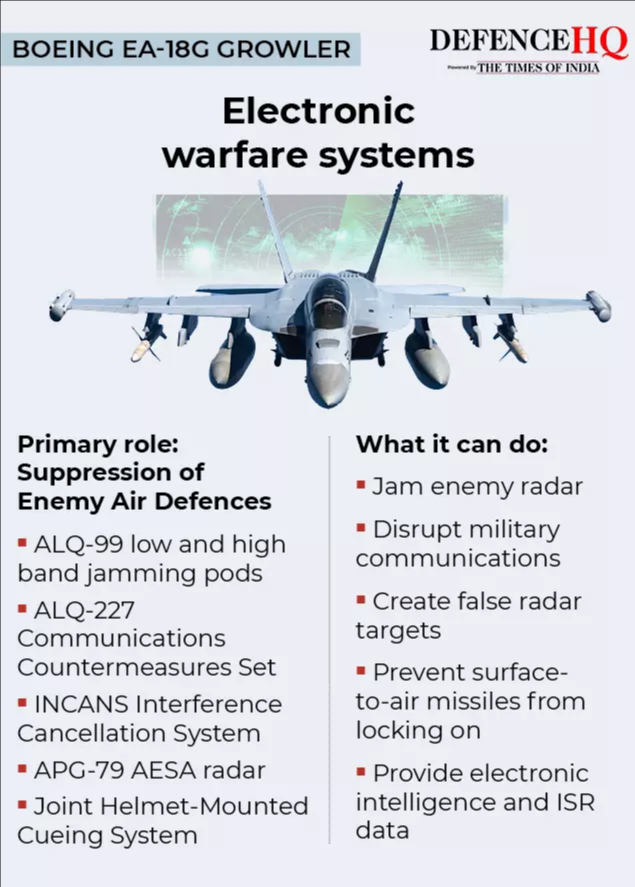
The future battlefield will make EW even more important because drones, satellites and AI systems all depend on communications.
India has built a substantial foundation in this field.The Navy’s Samudrika programme includes systems such as SHAKTI, NAYAN, TUSHAR, SARANG, SARAKSHI, SARVADHARI and NIKASH for shipborne and airborne EW.The Army’s Himshakti is specifically optimised for high-altitude mountain warfare.Meanwhile, the D-29 EW Suite is an indigenously built system integrated with the Su-30MKI fighter aircraft.The future battlefield will make EW even more important because drones, satellites and AI systems all depend on communications.
6. Satellite warfare: The era of Star Wars
Modern militaries are increasingly dependent on space.Satellites provide communications, navigation, missile warning, weather information, electronic intelligence and imagery. Destroying or disabling them can therefore cripple an entire military network.The US demonstrated anti-satellite capability in 2008 during Operation Burnt Frost, when an SM-3 missile destroyed the malfunctioning USA-193 satellite. America has since developed the X-37B reusable spaceplane which can remain in orbit for long periods.America is also developing ways to fight without necessarily blowing up an enemy satellite. Its Counter Communications System is a mobile EW system designed to jam satellite communications of adversaries.China tested an anti-satellite weapon in 2007 when an SC-19 interceptor destroyed the Fengyun-1C weather satellite. It has also developed sophisticated EW capabilities capable of interfering with satellite communications and navigation signals.Russia has the Nudol anti-satellite missile system, which it used in 2021 to destroy the Soviet-era Cosmos 1408 satellite in low Earth orbit.India demonstrated its anti-satellite capabilities in 2019 through Mission Shakti. A DRDO-developed PDV Mk-II ballistic missile destroyed an Indian satellite in low Earth orbit.India also established the Defence Space Agency in 2019, a dedicated tri-service command to manage space warfare operations, counter-space defences, and space situational awarenes. It also operates dedicated defence satellites including GSAT-7 (Rukmini) for naval command-and-control, GSAT-7A (Angry Bird) for IAF network-centric operations, and RISAT-2BR1/3 all-weather radar imaging satellites.
7. Cyber weapons: Attacking without crossing a border
Cyber warfare is arguably the least visible weapon on this list and most likely to be used first in a future war.A cyberattack can target command networks, logistics databases, power infrastructure, communications systems or military software without a conventional missile crossing a border.America’s famous Stuxnet operation against Iran’s nuclear programme demonstrated how cyber capabilities could produce physical effects by manipulating industrial machinery.Other operations such as Russia-linked attacks on Ukrainian infrastructure demonstrated the strategic potential of cyber warfare.AI has made cyberwarfare even more effective and expansive.Capabilities of countries are hard to ascertain as most nations closely guard the cyberweapons they have in their arsenal.India’s Defence Cyber Agency (DCyA), a tri-service command, has been tasked with handling offensive cyber capabilities and network defence across all military sectors. It has also developed Maya OS, an indigenously developed, hardened Linux-based operating system to eliminate vulnerabilities associated with commercial operating systems.The important shift is toward cyber resilience rather than simply building a larger firewall.
The big picture
The new arms race is not simply about building better weapons. It is about making different weapons work together as a single, connected combat system.That is the real revolution in modern warfare: the network is becoming the weapon.A hypersonic missile may travel at several times the speed of sound, but its effectiveness depends on the network that detects, identifies and tracks its target. A drone swarm becomes far more dangerous when artificial intelligence can coordinate hundreds of machines. A laser weapon is only as effective as the radars, sensors and command networks that guide it.These technologies are no longer operating in isolation. Their real power comes from how they connect with one another.The battlefield of the future will not be divided neatly into air, land, sea, space and cyberspace. These domains are increasingly merging into a single, interconnected battlespace.A military that can link satellites to radars, radars to AI systems, AI to autonomous platforms and those platforms to precision weapons could overpower an adversary whose more advanced weapons operate in isolation.The decisive advantage will increasingly come from detecting threats first, processing information faster, maintaining communications under attack, disrupting enemy networks and turning information into action before the opponent can respond.The next arms race, therefore, is not simply about who builds the fastest missile, smartest drone or most powerful laser.It is about who can make all of them fight as one.
Source link
Auto GoogleTranslater News